Plymouth Marjon University · PhD Research Study · Ethics ref. EP294
Take Part in Research: Brain Injury and Schools
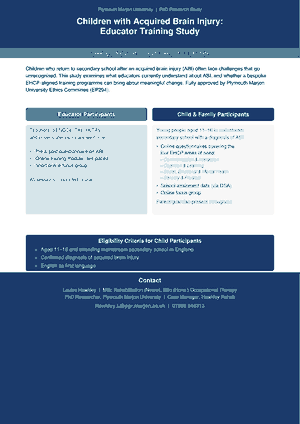
This research is being carried out by Louise Hawkley, a PhD candidate at Plymouth Marjon University and a practising neurological rehabilitation case manager. The study is looking at how well secondary school educators understand acquired brain injury (ABI), and whether a free training programme can improve their knowledge and make a difference to the wellbeing of the children they support.
This study has ethical approval from Plymouth Marjon University’s Research Ethics Committee (reference EP294).
Families
Could your family take part?
Your child may be able to take part in this research if they:
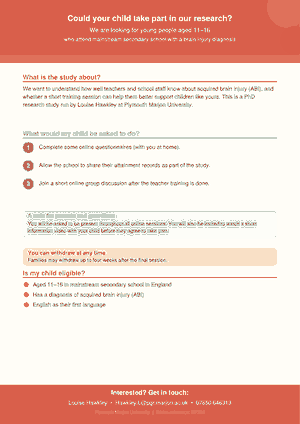
- are aged 11 to 16 and attend a mainstream secondary school in England
- have a diagnosis of acquired brain injury – this includes traumatic brain injury, stroke, brain tumour, infection, or any other cause
- are happy to take part (your child’s agreement is always required alongside yours)
- speak English as their first language
Your child may not be eligible if they have another diagnosis, such as autism or a significant learning difficulty, where that’s the main explanation for any difficulties at school, rather than the brain injury.
If you are not sure whether your child’s diagnosis counts as an acquired brain injury, please get in touch and we can discuss it.
What Happens
What would taking part involve?
For your child
Your child would complete a short questionnaire about how they are getting on at school. This takes about 10 to 15 minutes and is done online. They would complete it twice: once near the start of the study and once after their teachers have received the training.
They would also be invited to take part in a small online focus group (up to five young people) to talk about their experience of school. This takes about an hour and is done via Microsoft Teams. A parent or guardian must be present at home during all online sessions.
For you
As a parent or guardian, you would complete two short questionnaires about your child at the start of the study. One is about their communication and language, and one about how they respond to sensory information such as noise, light, or touch. Both can be done online or on paper, in your own time, and take around 20 to 30 minutes in total.
For your child’s school
The school also shares information about your child’s academic progress with the university. This is a required part of taking part, and is handled through a formal data-sharing agreement between the school and Plymouth Marjon University, kept confidential within the research team.
The school’s educators, including teachers, teaching assistants, and the SENCO, would be offered a free, one-hour online training programme on acquired brain injury, designed specifically for secondary schools and aligned to the Education, Health and Care Plan (EHCP) framework.
Before and after the training, educators complete a short questionnaire (about 15 minutes each time). No one needs to travel anywhere: everything is online and self-paced.
Your child’s agreement
Before anything begins, your child will be invited to watch a short video about their rights as a research participant. We ask that you watch it together so you can talk through any questions they have. If your child then wishes to take part, they will complete their own assent form alongside your consent.
Taking part is completely voluntary. Families and schools can withdraw at any point.
Why This Matters
Why does this matter?
Research consistently shows that many school staff have significant gaps in their knowledge of brain injury, not because they do not care, but because ABI is rarely covered in teacher training. Children with ABI are often misunderstood, mislabelled as having behavioural problems, or not supported in the ways that would actually help them.
This study aims to find out whether targeted, EHCP-aligned training can change that, and whether it makes a measurable difference to how children feel about their school experience.
Your child’s school would receive the training at no cost and would be contributing to the first UK research of this kind designed specifically for the secondary school context.
What does my family get from taking part?
Taking part does not provide individual clinical assessments or recommendations for your child. The questionnaires are research tools and the results are not fed back to the school. The direct benefit is that your child’s school receives free, specialist training on brain injury at no cost. The wider benefit is helping schools across England better understand and support children with ABI in future.
Your Data
Your data and privacy
All information collected is kept strictly confidential and stored securely on Plymouth Marjon University’s systems. No child is ever identified by name in any research output. Participation is voluntary, and families may withdraw up to four weeks after their final session without giving a reason.
There is one important exception: if anything shared during the research raises a safeguarding concern, this will be passed on to the appropriate people. You and your child will be reminded of this at the start of each session.
For more information on how data is handled, please get in touch.
Get In Touch
Interested? Get in touch
If you would like to find out more, or if you think your child or school may be eligible, please email or call. Louise will respond to all enquiries personally, and there is no obligation to take part after making contact.
07850 646313
You can also download the family information sheet (PDF).
This study has ethical approval from Plymouth Marjon University’s Research Ethics Committee (reference EP294). Researcher: Louise Hawkley, PhD candidate, Plymouth Marjon University. Supervisors: Dr Jonathan Harvey and Dr James Tonks.
